MetaTrader API · 11 min read · 2026-08-27
Which Providers Support FIX API Connectivity to MT4 and MT5 Bridges?
By API2Trade Editorial Team
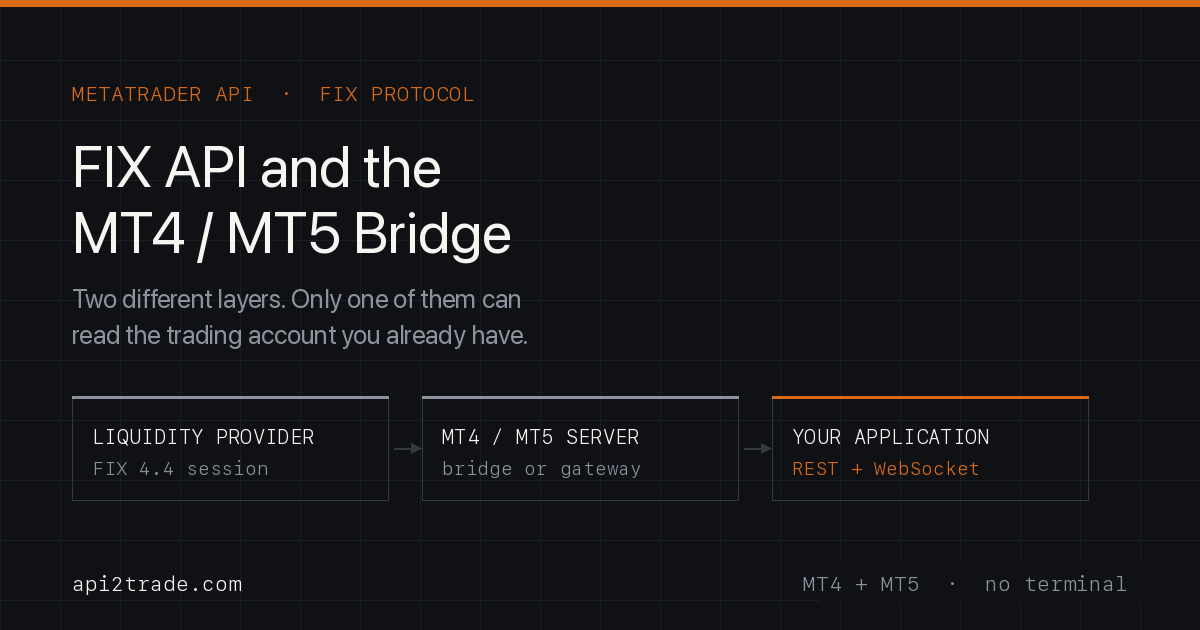
A straight answer on FIX API and MetaTrader bridges: which vendors actually sell them, what they cost, which brokers hand FIX sessions to clients — and why FIX cannot read the MT4 or MT5 account you already have, no matter which provider you pick.
Short answer: the established MT4/MT5 bridge and gateway vendors with FIX connectivity are oneZero, PrimeXM, Centroid Solutions, FXCubic, Gold-i, Tools for Brokers, Takeprofit Tech, Brokeree Solutions, Match-Trade and YourBourse, usually resold inside turnkey packages from firms like B2Broker. But that list only matters if you are a broker. A bridge connects a MetaTrader server to liquidity — it does not give an outside application access to a trading account.
That distinction is the whole article, and it is the thing almost nobody spells out. Two very different things get called "FIX API for MT4/MT5", and picking the wrong one costs months.
The two layers people confuse
Layer 1 — broker side: the bridge or gateway
Your MetaTrader server needs prices, and it needs somewhere to offload risk. A bridge (MT4) or gateway (MT5) sits between the trade server and one or more liquidity providers, speaking FIX 4.4 upstream — still the dominant version in retail and institutional forex, with FIX 5.0 SP2 appearing where more complex order types are needed.
The gateway translates: it receives external prices, injects them into the platform's symbol feed, routes eligible orders out for execution, and pushes fills, partial fills, rejects and status updates back into the MetaTrader order and position model.
MT5 has a Gateway API — a C++ framework MetaQuotes ships specifically for building these connectors, which is why MT5 gateways feel more native than MT4's bolt-on bridges. MT4 has no equivalent; MT4 bridges are built against the Server API and live beside the platform rather than inside it.
You need this if you operate a brokerage. You cannot buy it as an individual trader, and it will not let your Python script read an account balance.
Layer 2 — client side: a FIX session of your own
Separately, some brokers will give a client a FIX session: your own credentials into their execution venue, so your system sends orders as FIX messages instead of clicking a platform.
Here is the part that surprises people: that session usually bypasses MT4 and MT5 completely. You are talking to the broker's execution engine, not to a MetaTrader account. Positions you open over FIX may not appear in the MT5 terminal, the account you trade may be a different account entirely, and none of your existing EAs, history or MetaTrader tooling comes along.
FIX is a plumbing protocol between institutions. It was never designed to be a remote control for a retail MetaTrader account.
So which providers actually sell FIX connectivity?
Three groups, and they sell to three different buyers.
Bridge and gateway vendors (sell to brokers)
| Vendor | What it is |
|---|---|
| oneZero | Hub and aggregation platform; long-established with MT4/MT5 brokerages |
| PrimeXM | XCore aggregation and bridging, colocated in the main financial data centres |
| Centroid Solutions | Bridge, risk management and automation; FIX, Web and other API types |
| FXCubic | Strong mid-market aggregation and bridging option |
| Gold-i | Matrix bridge, widely deployed on MT4/MT5 |
| Tools for Brokers | Trade Processor bridge; other platforms connect over REST or FIX |
| Takeprofit Tech | MT4 bridge and MT5 gateway products |
| Brokeree Solutions | Multiple MT5 gateways, several listed in the MetaQuotes App Store |
| Match-Trade, YourBourse, Finstek, Brokeret | Bridge or gateway offerings, often bundled with wider broker infrastructure |
| B2Broker | Turnkey brokerage packages that integrate third-party bridges such as Centroid and oneZero |
Reported pricing for bridge software sits roughly between $1,000 and $10,000+ per month, before liquidity, colocation or the MetaTrader licence itself. Treat that as an order of magnitude, not a quote — every deal is negotiated, and volume tiers move it.
Brokers that offer FIX to clients
Names that regularly come up include IC Markets (via cTrader FIX), Pepperstone, IG, Saxo Bank, Dukascopy, LMAX, Advanced Markets, CFH/Finalto, Sucden Financial and FXCM Pro.
Commonly quoted entry requirements: around $10,000–$25,000 for a professional-tier retail account, and $100,000+ at prime-of-prime aggregators, often with a monthly volume commitment on top. A venue advertising "FIX API" at a $500 minimum is usually offering something considerably narrower than a full session — read the spec before you build against it.
Confirm current terms directly with the broker. These requirements change, they vary by entity and jurisdiction, and no third-party list stays accurate for long. Our own broker directory covers 3,272 brokers with regulation, leverage, spread type and EA policy — deliberately not FIX availability, because FIX access is a negotiated commercial arrangement per client, not a platform feature we could verify at scale and keep honest.
Liquidity providers and prime brokers
The upstream end of the FIX session. Relevant when you already run a brokerage and are choosing where flow goes. Not something an application developer buys.
The question behind the question
Most people searching for "which providers support FIX API connectivity to MT4 and MT5 bridges" are not building a brokerage. They want one of these:
- read balance, equity and open positions from an MT4/MT5 account, on demand
- place, modify and close orders from their own code
- stream live quotes and fills into a dashboard, a CRM or a bot
- do all of that for many accounts — their users' accounts, not just one
FIX does none of that. Not with oneZero, not with PrimeXM, not with any bridge on the market. A bridge moves liquidity into a MetaTrader server; a client FIX session sidesteps MetaTrader entirely. Neither one reads the account your user just handed you credentials for.
What does that job is a protocol-level MetaTrader API: something that logs into the broker's server the way a terminal does, holds the session, and exposes it as JSON over HTTPS. That is what API2Trade is.
Decide in one table
| What you are actually doing | The right layer | Realistic cost |
|---|---|---|
| Running a brokerage, need LP prices and STP execution in your MT4/MT5 server | Bridge or gateway vendor over FIX | ~$1k–$10k+/month plus liquidity |
| Trading your own size, want a raw session into a venue and can meet the minimums | Broker-provided client FIX session | $10k–$100k+ deposit, volume commitments |
| Building software that reads and trades MT4/MT5 accounts — bot, CRM, copy trading, prop dashboard | MetaTrader REST/WebSocket API | From €12/month |
Three genuinely different problems. The first two are infrastructure procurement. The third is an integration, and it is where nearly everyone asking this question actually lives.
What FIX costs you in engineering, not money
Even when FIX is the correct answer, budget honestly for it. A FIX session is not an HTTP call:
- Session management. Logon, heartbeats, test requests, logout, and a session that must be re-established cleanly after every disconnect.
- Sequence numbers. Both sides count messages. A gap triggers a resend request, and mishandling one can duplicate orders or wedge the session until it is reset out of hours.
- No state. FIX streams events. Current positions, aggregate exposure, per-account P/L — you build and maintain those yourself, correctly, including after a reconnect mid-fill.
- Per-venue dialects. "FIX 4.4" is a starting point. Every counterparty has custom tags, quirks and its own certification process before you go live.
- Certification. Expect a formal conformance test with the counterparty, on their schedule.
Teams routinely spend a quarter on this before their first production fill. That is a reasonable price for genuine institutional execution. It is an absurd price for "I want my dashboard to show a client's equity".
What the REST layer gives you instead
curl -X GET "https://api.api2trade.com/AccountSummary?id=YOUR_ACCOUNT_UUID" \
  -H "x-api-key: YOUR_API_KEY"
That is the entire integration surface: an API key in a header, an account UUID as id. No session state, no sequence numbers, no certification, no counterparty dialect.
Concretely, against MT4 and MT5:
- 104 documented endpoints in the current PRO specification — orders, history with pagination, symbol parameters, required margin, trade sessions, equity history, trade statistics.
- Real-time streaming over WebSocket —
/Subscribeplus the/eventsconnection gives quotes, order updates, floating profit, market watch, order book and OHLC. - Unlimited accounts on a flat monthly fee, not per-account billing. A copy-trading platform with 400 followers costs the same as one with four.
- No terminal and no Expert Advisor anywhere in the architecture — nothing to install, crash, or keep alive on a Windows box.
- One integration for both platforms. MT4 is not going away; anything MT5-only makes MT4 your problem.
Published infrastructure figures: 47 ms average execution (US-East → London), a 99.95% uptime SLA, 11 global data centres, over 10,000 active accounts, clients in 196 countries.
For the architectural comparison against cloud-terminal wrappers, see MetaApi vs direct MetaTrader API. For the setup itself, how to get an MT5 API key walks the whole thing in five steps.
Where we are honest about the boundary
API2Trade is not a FIX venue, and does not pretend to be. We do not aggregate liquidity, we are not a bridge vendor, and we are not a broker. If you need FIX sessions into liquidity providers for a brokerage you operate, the vendors listed above are who to call, and you should call several.
What we do is the layer they cannot serve: programmatic access to MT4 and MT5 trading accounts, from any language that can make an HTTP request, at a price that does not scale with your user count. For a prop firm enforcing rules across hundreds of funded accounts, a CRM syncing balances, a signal service, or a copy-trading platform, that is the correct — and honestly, the only sane — layer to build on.
If FIX is genuinely what you need, we would rather tell you so than sell you the wrong thing. That is also why the sentence above exists in an article that ranks for FIX.
FAQ
Which providers support FIX API connectivity to MT4 and MT5 bridges? Established bridge and gateway vendors include oneZero, PrimeXM, Centroid Solutions, FXCubic, Gold-i, Tools for Brokers, Takeprofit Tech, Brokeree Solutions, Match-Trade and YourBourse, often resold through turnkey providers such as B2Broker. These connect a broker's MetaTrader server to liquidity over FIX; they are sold to brokerages, not to application developers.
Can I use FIX API to trade my existing MT4 or MT5 account? Generally no. A client FIX session connects to the broker's execution venue and typically bypasses MetaTrader entirely, so it does not read or control an existing MT4/MT5 account. To operate a MetaTrader account programmatically you need a MetaTrader REST/WebSocket API.
Do MT4 and MT5 support FIX natively? Not to end clients. MT5 provides a Gateway API for building connectors to external systems, and MT4 bridges are built against the Server API. Both are broker-side integrations.
How much does an MT4/MT5 bridge with FIX cost? Reported industry pricing is roughly $1,000 to $10,000+ per month for the bridge software, excluding liquidity, colocation and MetaTrader licensing. Client FIX accounts at brokers commonly require $10,000–$25,000, and prime-of-prime venues $100,000+.
What FIX version do MetaTrader bridges use? FIX 4.4 is the most widely used version across retail and institutional forex infrastructure, with FIX 5.0 SP2 supported by some liquidity providers and prime brokers for more complex order types.
What is the alternative to FIX for MT4/MT5 automation? A protocol-level REST and WebSocket API such as API2Trade, which connects directly to the broker's MetaTrader server without a terminal or Expert Advisor, exposes 104 endpoints across MT4 and MT5, and bills a flat monthly fee for unlimited connected accounts from €12/month.
Build on the right layer
If your problem is liquidity, call a bridge vendor. If your problem is software that has to read and trade MetaTrader accounts, that is a REST integration and it takes an afternoon, not a quarter.
👉 See API2Trade pricing and start building — or read the endpoint documentation first.
API2Trade is an independent service and is not affiliated with, authorized by, or endorsed by MetaQuotes. "MetaTrader", "MT4" and "MT5" are registered trademarks of MetaQuotes Ltd. All other company and product names are trademarks of their respective owners and are referenced for identification purposes only. Vendor capabilities, broker requirements and pricing ranges reflect publicly reported information as of August 2026 — verify current terms with the provider directly.
Ready to integrate the MetaTrader API?
Set up in under 30 minutes. No terminal required.
Get Started →