MetaTrader API · 8 min read · 2026-06-09
MetaApi vs Direct MetaTrader API: Which Setup Is Better for Your SaaS or Trading App?
By API2Trade Editorial Team
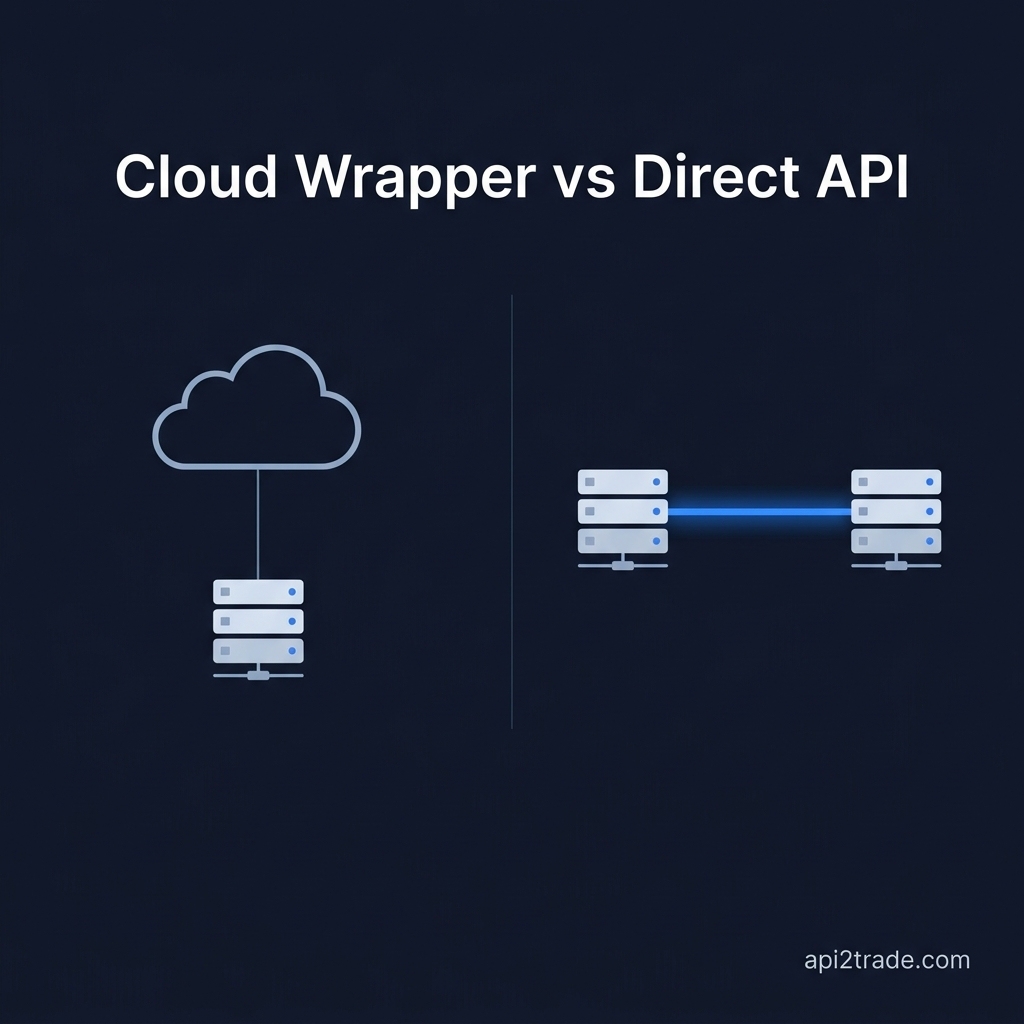
A technical comparison of MetaApi vs direct MetaTrader API configurations. Discover how cloud REST wrappers compare to direct MT4/MT5 protocol integrations in latency, control, and scalability.
A technical comparison of MetaApi vs direct MetaTrader API configurations. Discover how cloud REST wrappers compare to direct MT4/MT5 protocol integrations in latency, control, and scalability.
When technical founders and CTOs set out to build a trading platform on top of MT4 or MT5, one of the earliest architectural decisions is choosing the data transport layer. The primary debate almost always comes down to MetaApi vs direct MetaTrader API access.
On one hand, you have cloud wrappers like MetaApi that offer an incredibly fast sandbox setup. On the other, you have direct integrations—ranging from the C++ MT5 Manager API to modern protocol-level REST bridges—that offer significantly more control over latency and scaling costs.
In this technical breakdown, we analyze the core differences between an MT4 API cloud vs direct setup, looking at execution speed, stability, and exactly when each architecture makes sense for a commercial SaaS.
1. The Cloud Wrapper Approach (MetaApi)
When you compare a MetaTrader REST API vs MetaApi, you have to understand exactly what MetaApi is doing behind the scenes. It is a cloud wrapper. When you connect an account, MetaApi spins up a virtual, headless MetaTrader terminal hosted on their own cloud infrastructure.
Your Node.js or Python backend talks to the MetaApi cloud, the MetaApi cloud talks to the headless terminal, and the headless terminal talks to the broker.
The Advantages:
- Rapid Prototyping: Because they handle the terminal deployment, you can connect a test account and place your first trade in minutes. It is arguably the easiest way to start if you are a solo developer experimenting in a sandbox.
- Built-in Synchronization: They offer high-level SDKs that handle state synchronization out of the box, shielding you from the raw complexities of MT4/MT5.
The Drawbacks:
- The "Middleman" Latency: Because you are routing through a heavy cloud terminal rather than communicating directly with the broker's protocol, latency is inherently higher.
- Inflexible Scaling: As your SaaS grows, you pay for the computing power required to keep hundreds of virtual terminals running. This makes scaling a prop firm or copy trading platform cost-prohibitive.
2. The Direct MetaTrader API Approach
"Direct" API access can mean a few different things depending on your relationship with the broker.
If you are a broker, a direct integration means using the official C++ MT5 Manager API. This grants you root-level access to the trade server, allowing you to manipulate balances, execute trades with zero latency, and manage groups. However, 99% of retail brokers will not grant Manager API access to third-party SaaS platforms.
For independent B2B and B2C SaaS platforms, a direct API means using a protocol-level REST bridge—like API2Trade.
Unlike a cloud wrapper, a protocol-level API strips away the headless terminal. It translates your JSON REST payload directly into the raw TCP/IP protocol that the MetaTrader server natively understands.
The Advantages:
- Maximum Control & Stability: Because there is no virtual terminal that can crash or freeze, the connection is vastly more stable.
- GEO-Optimized Latency: A critical advantage in the MetaApi vs direct MT5 API debate is geographic routing. Protocol-level APIs allow enterprise clients to deploy API nodes in specific financial data centers (like Equinix LD4 in London or NY4 in New York) directly adjacent to the broker's servers.
- SaaS-Friendly Economics: Without the overhead of virtualizing terminals, the cost-per-account drops dramatically. Protocol-level APIs are inherently designed to support platforms managing thousands of retail users.
The Drawbacks:
- Slightly Steeper Curve: Protocol APIs often give you raw, un-opinionated data. You are responsible for handling your own business logic rather than relying on a heavy SDK to do the thinking for you.
(To see how a direct protocol API scales in production, read our guide on How Brokers Automate Account Management).
3. MT5 Manager API vs MetaApi
If you do have deep partnerships with brokers, you might be deciding strictly between the MT5 Manager API vs MetaApi.
- Choose the Manager API if: You need to programmatically create new MT5 accounts, perform mass balance operations, or configure spread markups.
- Choose a REST API if: You are building an external client-facing dashboard, a CRM integration (like Salesforce to MetaTrader), or a copy trading app where users connect their own passwords.
It is worth noting that modern REST providers like API2Trade also offer Manager API endpoints wrapped in clean JSON, providing the best of both worlds if you have the requisite broker permissions.
The Verdict: Which Setup Wins?
The debate between MetaApi vs MetaTrader API configurations ultimately depends on the maturity of your product.
When to use a Cloud Wrapper (MetaApi): If you are a hobbyist, a student, or a founder building a minimal viable product (MVP) to test an algorithm on a single account, the faster setup time of a cloud wrapper is a major benefit.
When to use a Direct Protocol API (API2Trade): If you are a serious SaaS founder, a prop firm operator, or a technical team building an application that must scale to hundreds or thousands of concurrent users, a direct protocol-level API is non-negotiable.
The latency reductions, stability improvements, and economic scaling of an API that speaks directly to the broker’s servers will dictate your long-term profitability.
👉 Compare API2Trade's Direct REST Infrastructure Today
Ready to integrate the MetaTrader API?
Set up in under 30 minutes. No terminal required.
Get Started →